
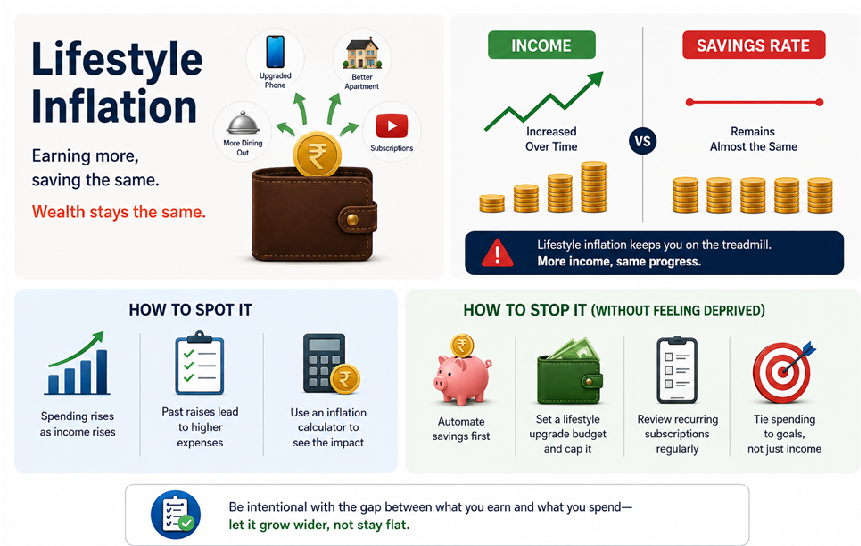
Every salary hike feels like a win until you realize, a year later, that your savings rate hasn’t moved despite earning significantly more. This is lifestyle inflation: the quiet, almost invisible tendency to increase spending in step with income, leaving wealth-building no further ahead than before the raise.
How lifestyle inflation creeps in
It rarely happens through one big decision. It’s the upgraded phone after a bonus, the slightly nicer apartment after a promotion, the more frequent dining out, and the subscription services that accumulate one at a time. Each choice seems reasonable and affordable on its own. Collectively, they absorb every rupee of additional income, and sometimes more, if lifestyle upgrades are financed through EMIs or credit.
Why it’s dangerous
Unlike a visible expense spike, lifestyle inflation doesn’t trigger alarm bells because your bank balance still looks fine month to month. The real cost shows up over years in a retirement corpus that falls short, emergency funds that never get built, and financial goals that keep getting pushed further out, even as your income grows substantially over a career.
The compounding cost
Money not saved today doesn’t just represent a missed contribution; it represents lost compounding over decades. An extra ₹10,000 saved and invested monthly starting at age 30 versus starting at age 40 can result in a dramatically larger corpus by retirement, purely due to the extra decade of compounding. Lifestyle inflation doesn’t just cost you today’s savings; it costs you tomorrow’s growth on that money.
How to spot it in your own finances
- Compare your savings rate (not just amount) year over year. If your income has grown but your savings percentage hasn’t, that’s lifestyle inflation at work.
- Track discretionary spending categories (dining, subscriptions, shopping) against income growth over the past two to three years.
- Check whether past raises correlate with new recurring expenses or genuine increases in your investment contributions.
- Run an inflation calculator to see how rising costs and lifestyle creep eat away at your real buying power and savings potential over time.
How to End it Without Feeling Deprived
Automate Savings Bumps With Salary Hikes
Before your raise even hits your spendable account, promise a certain percentage of each raise to investments.
Budget for lifestyle upgrade
Allow yourself to have some of the extra income to play with, but consciously limit it, rather than letting the spending run rampant.
- Review subscriptions and commitments annually
- Small monthly costs add up to large annual leakage.
- Tie spending increases to goals, not just income
Ask whether a lifestyle upgrade serves a genuine priority or is simply default behavior.
Lifestyle inflation isn’t about denying yourself the benefits of a growing income; it’s about being intentional with the gap between what you earn and what you spend so that gap consistently widens rather than staying flat or shrinking as your career progresses.
To understand exactly where lifestyle inflation may be affecting your long-term financial goals, a structured financial wellness check on AirPay Money can help identify savings gaps and give you a clearer picture of whether your spending is keeping pace with or outrunning your income growth.